
Official Website of the
Catholic Diocese of Little Rock
Bishop addresses polarization, partisanship
Published: January 24, 2026
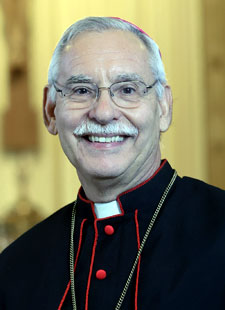
Bishop Anthony B. Taylor issued this statement Jan. 24, 2026, on polarization and partisanship in today's world.
"My grandfather lost 20 first cousins in the Holocaust, and so I admittedly tend to view troubling things in today’s world through the lens of 1930s Germany.
"Lest anyone dismiss the remainder of my statement as hyperbolic, I want to be clear that the current times are not identical, and Trump is no Hitler. But the moral decline of our country is real. And we are doomed to repeat failures of the past if we are not willing to remember them and learn from them.
 "Polarization and partisanship are poisoning the social fabric of our country. In this, there are many obvious parallels with 1930s, and that should give us pause.
"In Hitler, Germany had an eloquent speaker who was able to tap into the understandable fears and anger of people in the wake of the country’s catastrophic losses in World War I and the financial meltdown at the end of the 1920s. These people longed for their beloved homeland to be great once again, and many disaffected people resonated with Hitler’s talk of 'real' Germans, the Aryan race, and his mockery and demonization of those who were different racially or religiously or didn’t share his views.
"In the 1930s, Germany’s democracy was still young, its checks and balances insufficient, and its politicians too quick to go along with whatever direction the leadership pushed for — without critical thought or pushback. Those political opponents who did dare to oppose Hitler were silenced, initially through intimidation and threats, and eventually by being shipped off to Dachau and other concentration camps.
"The first Nazi concentration camp was for political opponents and other leaders in society, and it especially targeted those who resisted Hitler’s agenda. Fear of arrest and fear of Hitler’s thugs — the SA or 'Brownshirts' — silenced many who disagreed privately with the direction their society was headed. In that decade, German society moved away from respect for human dignity, peace and moral restraint.
" I fear that the same dynamics are now happening in our country with the decline of civil discourse.
"Hitler dismantled and weaponized the legal system and assumed dictatorial powers. Momentum grew, and the now-silenced opposition was powerless to stop him, so he simply escalated further — attacking and invading nearby countries, until with Russia, he bit off more than he could chew.
"His policy of 'Germany Over All' ('Deutschland Über Alles') had no respect for the sovereignty of other nations, no respect for their established borders, and no respect for the will of the people who lived in those countries. Hitler fabricated false reasons for his actions to disguise his true intentions. (He claimed that Jews were responsible for all Germany’s woes, and that Poland had invaded Germany first.)
"Migration — an inherent part of the human condition and human history — was also a big issue in the 1930s. Nazi Germany was glad for minorities to leave, but because of the Great Depression and increasing tension around the globe, few would receive refugees.
"For instance, the German ocean liner MS St. Louis, carrying 937 Jewish refugees was famously denied entry by Cuba, the United States and Canada and had to return to Europe. Some European countries accepted some of those refugees, but about a quarter of them perished later in the Holocaust — a painful reminder of the real human cost of closing borders to legitimate refugees and of inhumane immigration policies.
"When Germany invaded Poland, my grandfather’s cousins knew they were in great danger and had to flee. But when they tried to cross the border into what in 1939 was the Russian-occupied section of Poland, they found that the border was closed. They were turned back at Sanok, the border town on the San River between, then German- and Russian-occupied regions of Poland.
"So they just returned to their village in Galicia — what else could they do? This sealed their fate. In July of 1943, they were all caught up in a mass deportation and shipped to the extermination camp at Belzec where they were gassed and cremated.
"Obviously, these tragic examples are not what is happening here today. But these are the kinds of atrocities to which the dehumanization of mass, indiscriminate deportation can naturally lead. We have already experienced elements of this in sad chapters of the history of our own country — for instance, in the mass deportation of Native Americans in the Trail of Tears; the forced migration of millions of west Africans in the transatlantic slave trade; and the indiscriminate imprisonment of Japanese-Americans in internment camps during World War II (including two here in Arkansas).
"Today, our borders remain largely closed for those who are in greatest danger and must flee persecution or poverty. And now we have gone further and cut off most of our foreign aid — aid that would have reduced the need for hungry people to migrate to find a place where they could protect and provide for their family.
"I have just finished two terms on the board of directors of Catholic Relief Services, and so I have a clear understanding of the negative impact of the discontinuation of our government’s funding for USAID and other programs, which CRS administers through dioceses and local actors throughout the world.
"This is a pro-life issue. And it will remain a pro-life issue so long as millions of people continue to live lives trapped in desperate circumstances, where countries with means refuse to help.
"The United States is not Germany in the 1930s. But it is sobering to see similar patterns reemerging from that fateful decade. We have reason to worry about the direction our society has taken in recent years. And we have reason to work to shore up our democracy before it is too late."
"The United States is not Germany in the 1930s. But it is sobering to see similar patterns reemerging from that fateful decade. We have reason to worry about the direction our society has taken in recent years. And we have reason to work to shore up our democracy before it is too late.
"In closing, I implore every Catholic to read Pope Leo XIV’s Jan. 9 address to the Papal Diplomatic Corps. Pope Leo reminds us that in St. Augustine’s seminal work, 'The City of God,' Augustine reflects on fundamental issues, 'such as the search for a more just and peaceful coexistence among peoples. Augustine also warns of the grave dangers to political life arising from false representations of history, excessive nationalism and the distortion of the ideal of the political leader.'
"In a particularly poignant passage, Pope Leo then warns us: 'A diplomacy that promotes dialogue and seeks consensus among all parties is being replaced by a diplomacy based on force, by either individuals or groups of allies. War is back in vogue, and a zeal for war is spreading. The principle established after the Second World War, which prohibited nations from using force to violate the borders of others, has been completely undermined. Peace is no longer sought as a gift and a desirable good in itself ... . Instead, peace is sought through weapons as a condition for asserting one’s own dominion. This gravely threatens the rule of law, which is the foundation of all peaceful civil coexistence.'
"My hope and prayer is that, along with Pope Leo, we might strive toward peace as a good in itself. And if we think we are powerless to do anything to change the minds of our leaders, well, that’s exactly what many told themselves in Hitler’s time.
"But aside from our political situation, I pray that we will begin to look at the immigrants and refugees in our midst not as enemies or as 'other.' Not as different in color or in accent. Not as dangers or risks. But as created in the image and likeness of the same true God — as the stranger in our midst — as Jesus (Matthew 25:35). Peace be with you.
"Yours in Christ,
+Anthony B. Taylor
Bishop of Little Rock"