


Official Website of the
Catholic Diocese of Little Rock
The Baptism of the Lord 2026
Published: January 11, 2026
Bishop Anthony B. Taylor preached the following homily Jan. 11, 2026.
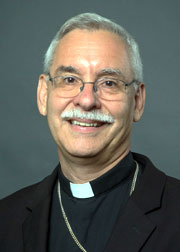
Bishop Taylor
All of us who have made our First Holy Communion were taught that there are seven sacraments and that these sacraments are outward signs instituted by Christ to give grace, so I ask you: How could baptism have been instituted by Christ if John the Baptist was already out there baptizing people?
And what about marriage? Jesus' own parents were married! How can we say that marriage and baptism were instituted by Christ?
The answer is that Jesus did not create the sacraments out of nothing. He took things people were already doing and turned them into life-changing moments of encounter with God. Marriage at that time was like civil marriage today, a contract between two persons that the civil authorities could terminate by granting a civil divorce.
You might be a bad Catholic or a fallen-away Catholic, but you're still a Catholic, whether you end up going to heaven or not.
What Jesus did was take ordinary marriage and turn it into a life-changing encounter with God, making it a covenant (not just a contract), a spiritual commitment (not just an agreement) between three people (the third party being God) and as such, having spiritual effects that come from God which (if the marriage is valid) cannot be undone by any human being.
In a similar way, dunking in water as a ritual of purification already existed in Israel for 1,000 years before the time of John the Baptist. Married women were purified at the end of their monthly period, and converts to Judaism were dunked prior to being circumcised.
What John the Baptist did was take this ritual of physical purification and turn it into a ritual of spiritual purification, a ritual of repentance, but as we will see later, more was yet to come.
Baptism did not become an outward sign instituted by Christ to give grace until after Easter when Jesus takes this ritual of purification and turns it into the sacrament of rebirth that I and most of you received as infants, uniting us to Jesus in his death so that we may also share in his resurrection, sharing in his victory over sin (purifying us of all actual sins and setting us free from the effects of original sin) and giving us eternal life, a share in his victory over death.
So what about the baptism of Jesus in today's Gospel? Jesus was sinless, so he didn't need to repent of anything but still he insists on being baptized for three reasons: 1) to validate John the Baptist's ministry, affirming that God had sent him to prepare the way for Jesus, 2) as an example to motivate others who definitely did need to repent of their sins, and 3) to give us our first glimpse of Jesus as the second person of the Blessed Trinity: the Spirit of God descending on him like a dove and a voice from heaven saying, "This is my beloved Son, with whom I am well pleased."
Why is this important? Because after his resurrection, when Jesus changes baptism into a sacrament, it will be a covenant between the believer and all three persons of the Blessed Trinity (not just Jesus), a foretaste of which we already see on the day of Jesus' own baptism in today's Gospel.
Just as with marriage, the sacrament of baptism has spiritual effects that come from God and cannot be undone by any human being. Which is why we say: Once a Catholic, always a Catholic, and as such you will be held to a higher standard than those who do not enjoy the advantages of our Catholic faith.
You might be a bad Catholic or a fallen-away Catholic, but you're still a Catholic, whether you end up going to heaven or not.
So where are you in your spiritual life? John the Baptist warned people to repent of their sins and put their lives in order while there was still time, and repentance is not just a one-time event. Rather, it is just the beginning of a life of progressive conversion, conforming our lives ever more closely to live ever more fully and faithfully the new life which began for us the day of our baptism.