





Official Website of the
Catholic Diocese of Little Rock
Thirtieth Sunday in Ordinary Time 2026
Published: October 25, 2026
Bishop Anthony B. Taylor preached the following homily Oct. 25, 2026.
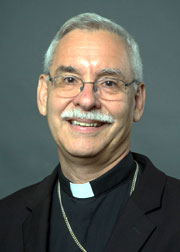
Bishop Taylor
When we say that something is most important, it implies that everything else is less important — and not just as a matter of opinion, but in reality.
In Jesus' time, there was a school of thought that said that all 613 commandments of the Old Testament were equally binding. They all had been commanded by God, and he expected us to obey all of them completely. Ritual laws, moral laws, social norms, dietary laws, it didn't matter. Remember the trouble Jesus got into for not washing his hands before eating? Or the grief they gave his disciples who were plucking grain to eat on the Sabbath?
We see the same thing today on the topic of immigration when people chant, "It's the law, it's the law, it's the law" as if all laws have equal binding force.
And this is the case today with our broken—and unjust—immigration system.
In today's Gospel, not only does Jesus state clearly that some laws are more important than others, when a scholar of the law asks him which is the most important commandment of the law, he gives a double answer: not one but two commandments paired together to form a single most important commandment of the law because you can't have one without the other: love of God and love of neighbor, love God with all your heart, soul and mind, and your neighbor as yourself.
These are not new commandments; Jesus is quoting Deuteronomy and Leviticus, but what is new is that he says that together they constitute the foundation not only of the other 611, but they are also more important than the other 611.
Jesus' bringing these two commandments together is a great advance, but you know there is a big problem here. Most people think that this is the greatest commandment of all. But it's not. What does our text say? The greatest commandment "of the law" meaning of the Old Testament. Moreover, loving our neighbor as ourselves may or may not be all that much — a lot of people don't love themselves much at all. Look at how they treat their bodies. Look at all the self-destructive choices they make!
The first half of this commandment will stand — love God with all your heart, soul and mind. But Jesus will later revise the second half when he gives us what is, in effect, the Greatest Commandment of the New Testament: "Love one another as I have loved you."
Not just love others as we love ourselves, which is at best limited, but rather to love others more than we love ourselves, to love others as Jesus loves us, which is unlimited, sacrificial and to the death. "No greater love is there than to lay down one's life for others."
Today we deal with many controversial topics rooted in many kinds of laws having to do with morality, social policy, human rights, decisions of our government and rules of our Church, but as we see, while they each have a claim on us, they are not all equally important, and sometimes they come into conflict with each other. Indeed, St. Pope John Paul II reminds us that beyond a certain point unjust laws not only become unenforceable, they also lose their binding force, even though they remain on the books.
This was the case with the Jim Crow laws of the era of legal — though unjust — segregation of the races. God’s law of human dignity — a higher law — conflicted with unjust human laws. And this is the case today with our broken—and unjust—immigration system. Laws that oppress people have no binding force, and beyond a certain point, like with the laws of racial segregation, it even becomes a sin to obey them.
Today Jesus is saying that the love of God and neighbor must be the foundation of all other laws — and as we shall see as the New Testament continues to unfold, it is precisely unjust moral, social, religious and governmental laws will lead to rejection of Jesus, the person of the Second Person of the Blessed Trinity, rejecting God, whom they were supposed to love with all their heart, soul and mind, and thus to the crucifixion of an innocent man whom they were supposed to love at least as much as they love themselves.